

Kharkiv,
Gromadyanska St., 11/13
18 Листопада 2026
Preparing to enter the European market, finding new partners, and understanding the specifics of working with EU clients — these were the key challenges addressed by the Go-To-Market Bootcamp, delivered as part of the ITBridge project.
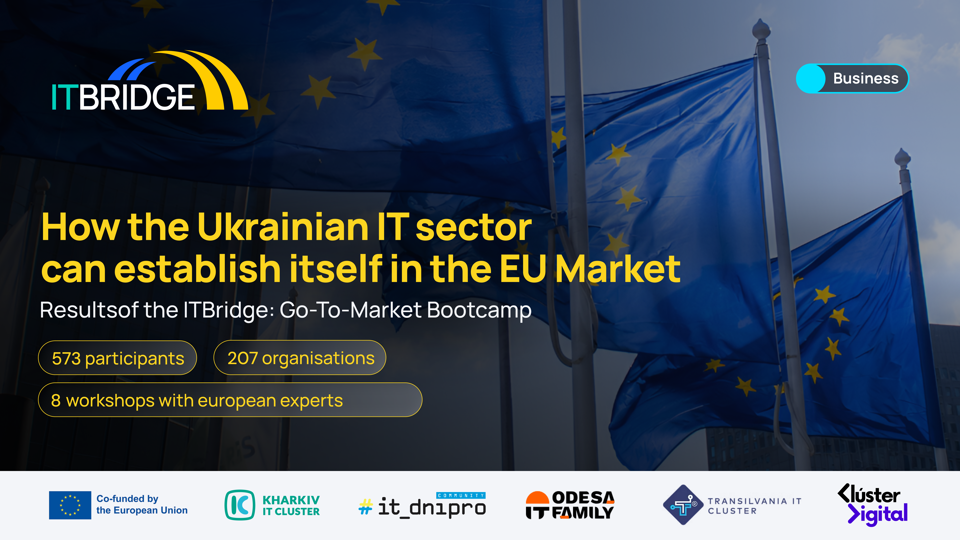
Across eight free workshops, Kharkiv IT Cluster, together with a consortium of Ukrainian and European IT clusters, brought together 280 participants from 207 organisations. The programme featured experts from various European companies.
Go-To-Market Bootcamp in Numbers
- 573 registered participants: 411 from Ukraine, 142 from EU countries, and 20 from other countries;
- 8 free workshops covering key areas of business development in the EU market;
- 491 attendances across all eight training sessions;
- 9.7 out of 10 — the average participant rating for the relevance and quality of the workshops.
The international mix of participants made it possible to combine Ukrainian expertise with European market practices, while 280 certificates confirmed successful completion of the programme.
European Expertise — Available to Everyone
The Go-To-Market Bootcamp brought together experts with experience in IT business development, international sales, fundraising, and navigating EU regulatory requirements.
Now, this knowledge is available not only to programme participants. Recordings of all eight workshops, presentations, and information about the speakers are available free of charge on the project page.
8 Key Areas for Scaling an IT Business in the EU
The programme covered the full journey of international business development: from assessing export readiness to finding partners, protecting intellectual property, and securing the first contracts.
1. Export Readiness and Sales in the EU
Entering the European market starts with understanding the value a company offers its customers. Potential clients want to know which business problem a product solves and what demonstrates the team’s expertise.
Núria Escofet, Founding Partner at Marc Prat, International Trade Consultant & Trainer, and Cristina Corominas, Consultant at N&N Consulting, shared approaches to assessing a company’s readiness to enter the EU market.
2. International Marketing
Positioning, communication, and promotion channels need to be adapted to each country’s business culture and audience expectations. Case studies, a professional LinkedIn presence, and the team’s expertise help build trust even before the first meeting.
Víctor Pérez, Digital Marketing Specialist and Key Account Manager at Fhios, explained how to adapt marketing strategies to the European market.
3. B2B Events and Brokerage Sessions
International exhibitions and business events deliver better results when a company identifies potential partners in advance, prepares a pitch, and formulates a clear request. Timely follow-up helps turn new contacts into negotiations and business opportunities.
Silvana Sanfeliu Giaimo, Head of EU Projects & Internationalisation at Fondazione Piemonte Innova, shared practical approaches to participating in international B2B events and brokerage sessions.
4. Grants, Investments, and Acceleration
European funding programmes create opportunities to develop technologies and participate in joint R&D projects. However, successful participation requires finding the right funding call, having a clear technological specialisation, and building a consortium with complementary expertise. Grants are one way to support business growth, but they should not replace a business strategy.
Maurits Butter, Senior Innovation Strategist and Business Development Expert at TNO, and Geraud Guilloud, EU Manager Strategy & Policy, presented opportunities in European funding, investment, and acceleration programmes.
5. Responsible AI Adoption
The AI Act, GDPR, and data governance requirements influence how technology products are developed and used in the EU. Regulatory compliance, data security, AI solution assessment, and team training should be integrated into business processes rather than treated as last-minute tasks before a product enters the market.
Dr Vladimir Estivill-Castro, Professor and international expert in AI and robotics at Pompeu Fabra University; Florian Schuck, Policy Officer; and Benedetta Beltrame, Junior Policy & Communications Officer at the European DIGITAL SME Alliance, discussed responsible AI governance and European regulatory requirements.
6. Hiring Talent in the EU
Business expansion requires an understanding of local labour markets. Recruitment strategies should account for candidate expectations, transparent employment conditions, and efficient selection processes. Partnerships with universities also help build a talent pipeline and attract young professionals to support company growth.
Darius Popîrțac, Founder of GetFrankly and expert in Executive Search and Leadership Advisory; Dan Suciu, Agile & Project Management Trainer and Associate Professor at Babeș-Bolyai University; and Ernest Teniente, Professor at Universitat Politècnica de Catalunya, Director of inLab FIB, and Co-founder and CEO of Algorae, presented strategies for attracting talent and building teams.
7. Intellectual Property and Commercial Contracts
In international partnerships, it is essential to define in advance who owns the development results, which rights are transferred to the client, and who is responsible for fulfilling contractual obligations. The scope of work, acceptance criteria, responsibilities of each party, and applicable law should all be clearly specified in the contract.
Dr. Miquel Mirambell Fargas, Counsel and Assistant Professor of Commercial Law at ESADE Business and Law School, and Míriam Serra i Casablancas, Junior Lawyer, explored the legal aspects of international cooperation.
8. Practical Experience of Entering the EU Market
The experience of companies that have already expanded into Europe helps reveal the real challenges of international growth. Securing the first clients, building local partnerships, adapting products, and understanding the needs of a specific market are all essential steps in turning plans to enter the EU into actual business contracts.
For Kharkiv IT Cluster, initiatives like this are part of its ongoing work to develop international cooperation in the Ukrainian IT sector. By bringing together companies, European experts, and partner organisations, the Cluster gives Ukrainian businesses access to knowledge, connections, and practical tools that help them operate more confidently in the EU market.
We thank all the speakers and companies that contributed to the Go-To-Market Bootcamp!
About the ITBridge Project and Go-To-Market Bootcamp
ITBridge is an international project that brings together IT clusters from Ukraine and the European Union to develop business cooperation, support digital transformation, and integrate Ukrainian IT companies into European value chains.
As part of this initiative, the Go-To-Market Bootcamp was launched as a practical, step-by-step programme designed to help IT companies, startups, scale-ups, and IT service providers position themselves successfully and expand their business in the EU market.
The programme is organised by Kharkiv IT Cluster, IT Dnipro Community, Odesa IT Family, Transilvania IT Cluster, and Cluster Digital de Catalunya.
The ITBridge project is funded by the European Union under the Single Market Programme, in accordance with Grant Agreement No. 101196018.
The views and opinions expressed are those of the authors only and do not necessarily reflect those of the European Union or the European Innovation Council and SMEs Executive Agency (EISMEA). Neither the European Union nor the granting authority can be held responsible for them.
Читайте також
Усі новини
The main pitfalls for Ukrainian IT companies when starting their expansion into the EU are offering generic outsourcing services, artificially lowering prices, and treating Euro...
Читати повністю
Entering the European market is a goal for many Ukrainian IT companies. But successful export isn’t driven by ambition alone — it begins with a clear answer to the question: wha...
Читати повністю
Clusters help Ukrainian IT companies find partners in Europe, enter new markets and participate in international projects.Kharkiv IT Cluster creates these opportunities as well....
Читати повністюSubscription to the email newsletter
Want to stay updated on the latest IT events in the region?
Subscribe to our newsletter!