

Kharkiv,
Gromadyanska St., 11/13
September 21, 2026
The main pitfalls for Ukrainian IT companies when starting their expansion into the EU are offering generic outsourcing services, artificially lowering prices, and treating Europe as a single, monolithic market.
In practice, a low price can actually raise concerns among European clients, as it may signal risks and weak internal processes. European clients are looking for reliability, compliance with local regulations, and predictability in cooperation.
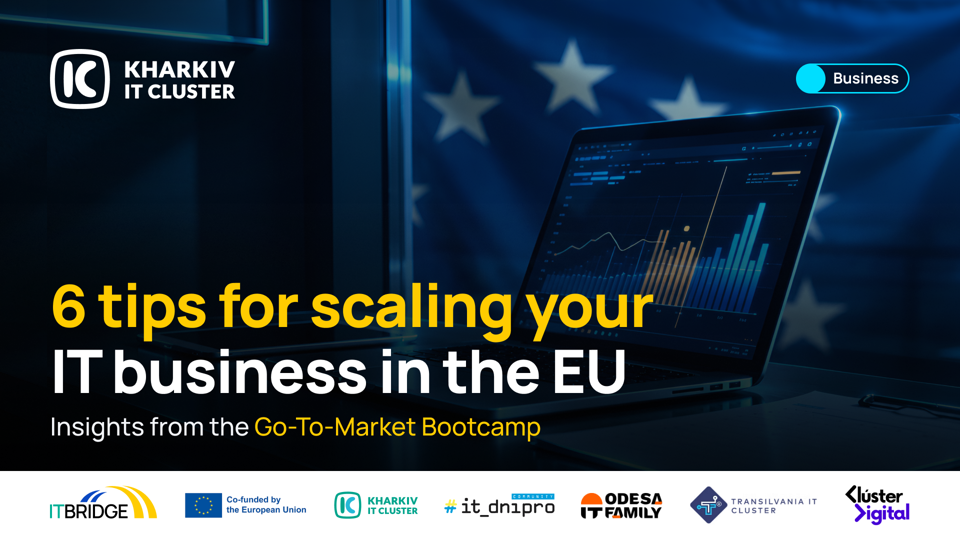
To provide businesses with systematic tools, Kharkiv IT Cluster, together with IT Dnipro Community, Odesa IT Family, Transilvania IT Cluster, and Cluster Digital de Catalunya, launched the Go-To-Market Bootcamp as part of the ITBridge project.
This is a practical step-by-step program consisting of 8 free workshops, designed to help IT companies successfully position themselves and scale in the EU market.
The speakers include European experts with hands-on experience in international B2B sales, fundraising, regulatory compliance, and ecosystem development.
Six practical workshops have already taken place, bringing together more than 300 industry representatives. Together with 13 speakers from Spain, Italy, the Netherlands, and Romania, participants explored practical approaches to entering the European market. All workshops are already available as recordings on the Go-To-Market Bootcamp program page.
We have collected the key takeaways that can be applied to your business right now.
1. Assessing Readiness for the EU
Expansion into the EU means adapting processes to European standards, not simply looking for clients. Secure contracts and compliance are the basic prerequisites for scaling.
- One set of rules instead of 27 borders. Adapting contracts, taxes, and compliance requirements to one country can serve as a template for entering other EU markets.
- Partnership as a fast-track entry strategy. Instead of the costly process of opening an office, SMEs can work through local integrators and agencies that already have an established client base.
- Do not underprice your services. A low rate may be perceived as a signal of regulatory and operational risks. European B2B clients are looking for a predictable and reliable partner.
- One market as a launchpad. Choose a country that matches your specialization, secure your first case studies and referrals, and only then scale into additional markets.
2. International Marketing
Simply translating a website into English does not deliver results — communication needs to be adapted to the business practices of each specific country.
- Adapt your messaging to the region. Instead of using universal offers, formulate your value proposition around the priorities of a specific client.
- Niche specialization instead of generic outsourcing. What converts is not general development services, but deep expertise in regulatory requirements and the pain points of clients within a specific industry.
- Build trust before the first contact. Up to 70% of a potential partner's research is conducted independently before the first conversation. LinkedIn profiles, verified case studies, and mentions on industry-specific platforms build credibility much faster than direct advertising.
3. B2B Events and Brokerage Sessions
Networking in the EU follows a structured process, where simply attending an event is only the middle of the process, not the beginning.
- Prepare your agenda 2–4 weeks in advance. Register early on partner platforms (including b2match and within the Enterprise Europe Network), complete your profile, and book B2B meeting slots so that you arrive with a fully scheduled calendar of meetings.
- Institutional trust. Participating in trade missions and brokerage sessions as part of clusters provides the status of a verified partner. This serves as a signal that the business has already been vetted by the local ecosystem.
- Follow-up discipline. Get in touch within the first few days after the event: send a short, personalized message summarizing the agreements reached and outlining a clear next step.
4. Grants and Funding
Grant programs provide access to partner networks and potential clients, and only then serve as a source of funding.
- Technology partnerships in consortia. For SMEs, it is often more practical to join established consortia, offer engineering expertise to major coordinators, and take responsibility for the technical implementation of specific tasks.
- Cascading grants (FSTP) for a fast start. These are sub-grants of €50,000–€150,000 for 6–12 months. The agreement is concluded directly with the project team through a simplified procedure, without complex reporting to the European Commission.
- EDIH network. More than 200 European Digital Innovation Hubs operate across the EU, allowing businesses to test their products free of charge on local infrastructure — helping them find their first customers in the local market.
5. AI Regulation and GDPR
To operate in the EU, technology businesses need to ensure transparency both in their handling of data and in the logic behind their algorithms.
- GDPR as an entry requirement. Compliance with data protection regulations is a mandatory condition for negotiations. A company should be ready to provide information on the physical location of its servers, access levels, and security protocols from the outset.
- EU AI Act. The level of regulation depends on the area in which AI is used. HR, credit scoring, biometrics, and critical infrastructure security are considered high-risk areas and may require audits, documentation, and certification.
- Algorithmic explainability and human oversight. The logic behind a model's decisions should be transparent, and people should have the right to review and change an automated decision.
6. Teams and Relocation
Building a team in the EU requires flexible solutions to avoid premature expenses and legal mistakes.
- Hybrid model and hiring through an EOR. The provider handles employment contracts, tax payments, and compliance. This allows companies to hire local professionals without establishing a legal entity until a stable team and long-term contracts are in place.
- Calculate compensation based on net pay. European candidates focus primarily on their net take-home pay. Agreeing on gross amounts without understanding local tax rates can lead to failed negotiations or unexpected costs.
Next Step: How to Sign a Legally Protected B2B Contract?
Finding a client in Europe is only part of the challenge. The main barrier often emerges when negotiating the contract: weak provisions can create risks of losing intellectual property or facing unexpected penalties.
On September 30, the 7th Go-To-Market Bootcamp workshop will explore the practical legal aspects of B2B agreements with European clients, based on a three-year case study of working with the Spanish branch of a German retailer:
- IT services agreements, payment structures, and deadlines;
- guarantees of code ownership, licensing, and preventing the loss of intellectual property;
- how to limit liability caps and allocate obligations;
- applicable law, choice of arbitration, and resolution of cross-border disputes.
Speakers:
- Dr. Miquel Mirambell Fargas — Counsel and Assistant Professor of Commercial Law at ESADE Business and Law School.
- Míriam Serra i Casablancas — Junior Lawyer
📅 September 30 | 11:00–12:30 | Online
Participants who attend or watch recordings of at least 60% of the program (5 out of 8 workshops) will receive an official certificate confirming their preparation for the EU market — a practical validation of their expertise for European clients.
About the ITBridge Project and the Go-To-Market Bootcamp Program
ITBridge is an international project that brings together IT clusters from Ukraine and the European Union to develop business cooperation, support digital transformation, and integrate Ukrainian IT companies into European value chains.
As part of the initiative, the Go-To-Market Bootcamp is being delivered — a practical step-by-step program designed to help IT companies, startups, scale-ups, and IT providers successfully position themselves and scale in the EU market.
This course is organized by Kharkiv IT Cluster, IT Dnipro Community, Odesa IT Family, Transilvania IT Cluster, and Cluster Digital de Catalunya.
The ITBridge project is funded by the European Union through the Single Market Programme under the grant agreement №101196018. Views and opinions expressed are however those of the author(s) only and do not necessarily reflect those of the European Union or European Innovation Council and SMEs Executive Agency (EISMEA). Neither the European Union nor the granting authority can be held responsible for them.
Read also
All news
Kharkiv IT Cluster is launching a new era of cooperation by signing a memorandum with the American non-profit organization TechHope Transitions Inc.The new international partner...
Читати повністю
Diia.Business is a support hub for the local business community, focused on entrepreneurship development and the digital transformation of small and medium-sized enterprises.Kha...
Читати повністю
Many entrepreneurs start their digitalization journey by searching for CRM, ERP, or other digital services. However, experts advise against rushing to choose software. The first...
Читати повністюSubscription to the email newsletter
Want to stay updated on the latest IT events in the region?
Subscribe to our newsletter!