

Kharkiv,
Gromadyanska St., 11/13
July 23, 2026
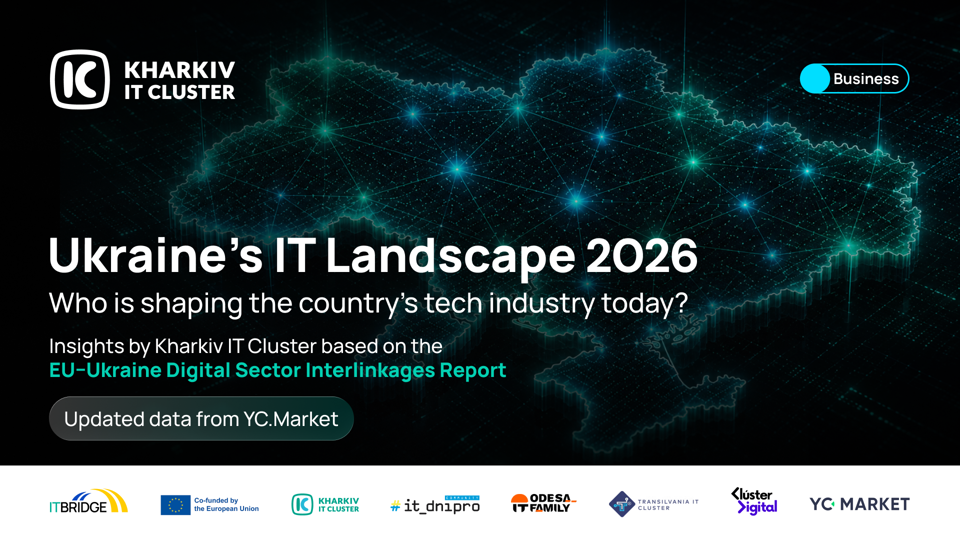
Kharkiv IT Cluster has analyzed the geography of Ukraine’s IT market as of the second quarter of 2026.
As of Q2 2026, Ukraine’s IT sector comprised 382,905 registered entities, including both sole proprietors (FOPs) and companies. However, beyond the headline figure, the underlying trends provide even greater insight. The geography of Ukraine’s IT industry is gradually becoming more stable, while the distribution of businesses across different technology segments indicates that the sector is reaching a new level of maturity.
This article is based on YC.Market analytics collected for the EU–Ukraine Digital Sector Interlinkages Report, prepared by the ITBridge project consortium.
The ITBridge project is implemented by Kharkiv IT Cluster, IT Dnipro Community, Odesa IT Family, Transilvania IT Cluster (Romania), and Cluster Digital de Catalunya (Spain) with the support of the European Union’s Single Market Programme.
Major IT Hubs Continue to Lead
Kyiv, Kharkiv Oblast, and Lviv Oblast remain the largest centers of Ukraine’s IT industry, jointly accounting for nearly half of the national market. This share has remained virtually unchanged over the past year.
The stability of these figures suggests that the spatial structure of Ukraine’s IT ecosystem has largely matured. The country’s largest IT hubs continue to maintain their leadership and remain the primary engines of industry development.
Immediately behind the top three is a group of regions that collectively account for approximately one-third of Ukraine’s IT market, including:
- Dnipropetrovsk Oblast;
- Odesa Oblast;
- Vinnytsia Oblast;
- Zaporizhzhia Oblast;
- Cherkasy Oblast;
- Poltava Oblast;
- Ivano-Frankivsk Oblast;
- and other regions.
This demonstrates that regional IT communities have long evolved beyond local initiatives and now represent a strong second tier of Ukraine’s technology sector, contributing a significant share of the national IT market.
Market Structure by Business Segment: A New Level of Stability
At the beginning of 2026, the Software Development sector experienced substantial growth, increasing its market share from 72% at the beginning of 2025 to nearly 80%. Data from the second quarter show that following this rapid expansion, the market structure has stabilized.
This suggests that the industry has entered a new stage of development. Opportunities for further redistribution among major business segments have largely been exhausted, resulting in a more balanced market structure.
Interestingly, among registered companies (as opposed to sole proprietors), Software Development represents only about half of all businesses. Meanwhile, Digital Marketing and R&D are much more frequently organized as legal entities, reflecting different business models across various segments of Ukraine’s IT industry.
Kharkiv Leads Among Ukrainian Cities
Looking beyond regions to individual cities, Kharkiv remains Ukraine’s largest IT center:
- Kharkiv — more than 30,800 IT companies and sole proprietors;
- Lviv — 23,617;
- Dnipro — 18,967;
- Odesa — 13,463.
Notably, the overwhelming majority of IT activity in Kharkiv Oblast is concentrated within the regional capital itself. This highlights Kharkiv’s position as a well-established and mature IT hub that continues to serve as one of Ukraine’s key technology centers despite its frontline status during the full-scale war.
Sole Proprietors Drive Regional Growth
Another notable trend is that large businesses are considerably more concentrated in Kyiv than individual IT professionals. Nearly every second IT company in Ukraine is registered in the capital, while Kyiv’s share among sole proprietors is significantly lower.
This indicates that independent professionals, small teams, and sole proprietors form the foundation of regional IT development, while larger corporate businesses continue to gravitate toward Kyiv.
For regional IT clusters and technology communities, this is an encouraging signal. It is within this ecosystem that the next wave of industry growth is taking shape, as local professionals and small teams gradually scale into fully-fledged technology companies.
The findings presented in this article are part of the broader EU–Ukraine Digital Sector Interlinkages Report, prepared by the ITBridge project consortium.
The full report provides an in-depth analysis of Ukraine’s IT market, including the structure of companies and sole proprietors, regional distribution, key technology segments, and Ukraine’s role within the European Union’s digital ecosystem.
Key Takeaways
The Q2 2026 data indicate that Ukraine’s IT industry has entered a stage of greater maturity. Its geographical structure remains stable: major IT hubs continue to lead the market, the second tier of regions maintains a substantial share, and regional growth is increasingly driven by sole proprietors and small technology teams.
At the same time, the distribution of business activities has also stabilized. Software Development continues to dominate the market, while other segments maintain relatively steady shares. Together, these trends demonstrate that Ukraine’s IT industry is not only continuing to grow but is also evolving into a mature and well-balanced technology ecosystem.
About the ITBridge Project
The EU–Ukraine Digital Sector Interlinkages Report has been prepared by a consortium consisting of Kharkiv IT Cluster, Transilvania IT Cluster (Romania), Cluster Digital de Catalunya (Spain), IT Dnipro Community, and Odesa IT Family as part of the ITBridge project—a strategic initiative aimed at strengthening cooperation between Ukraine and the European Union in the digital sector.
The ITBridge project is funded by the European Union through the Single Market Programme under Grant Agreement No. 101196018. Views and opinions expressed are however those of the author(s) only and do not necessarily reflect those of the European Union or the European Innovation Council and SMEs Executive Agency (EISMEA). Neither the European Union nor the granting authority can be held responsible for them.
Read also
All news
Український ринок C-level структурно змінюється. Конкуренція за керівників дедалі більше визначається якістю управління, автономією та впливом на бізнес, ніж рівнем компенсації....
Read more
Українські технологічні лідери обговорили, чому штучний інтелект не знецінює людський капітал, а навпаки робить його головною конкурентною перевагою країниНа Міжнародному економ...
Read more
Підготовка якісних фахівців починається раніше, ніж в університетах. Освітній напрям Kharkiv IT Cluster трансформує підхід до профорієнтації, створюючи умови, за яких підлітки т...
Read moreSubscription to the email newsletter
Want to stay updated on the latest IT events in the region?
Subscribe to our newsletter!