

м. Харків,
вул. Громадянська, 11/13
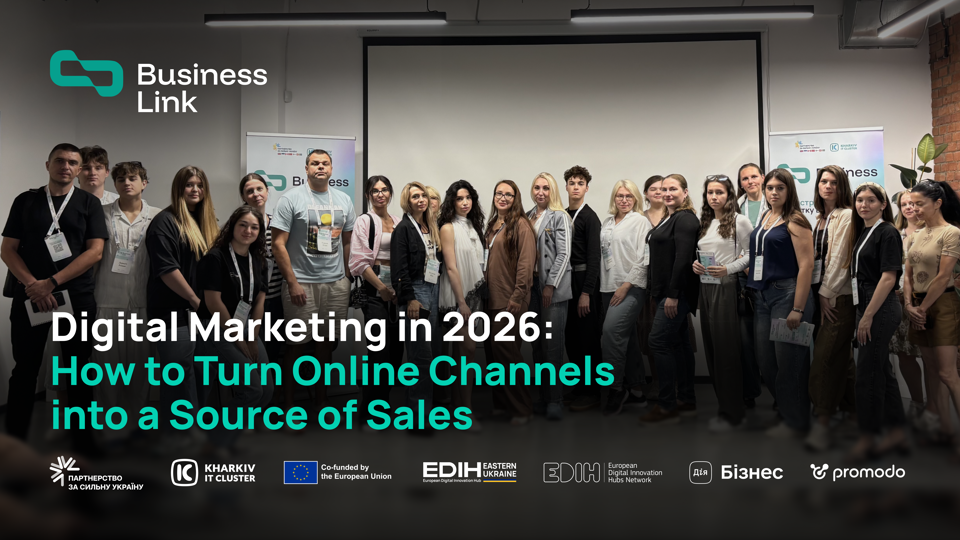
5–10 seconds. That is how long a business has to convince a website visitor to stay. On July 29, we brought business owners together for the practical Digital Marketing and E-commerce training held as part of the BusinessLink project. We explored why even a large advertising budget does not guarantee sales and how businesses can turn their websites and social media channels into effective sales tools.
This material is based on presentations by Ilona Bahdasarova, Head of New Project Development at Promodo and a lecturer at Promodo Academy, and Yuliia Kolomiitseva, a sales and marketing expert with more than 10 years of consulting experience who has built over 100 sales departments using the smarketing approach.
Which digital tool should you choose?
Ilona Bahdasarova emphasised that there is no universal tool that works equally well for every business. Each channel serves a different purpose:
- PPC advertising generates traffic and leads quickly, but only while the advertising budget is active;
- SEO provides long-term organic traffic without requiring a constant increase in spending;
- SMM is not primarily about direct sales, but about building relationships and increasing brand awareness;
- Email marketing offers one of the lowest customer acquisition costs among digital channels.
Each social media platform works differently
Publishing the same content across every social media platform is a common mistake. Each platform has its own audience:
- Instagram — products and the everyday life of the brand;
- Threads — short discussions;
- TikTok — reaching new audiences;
- LinkedIn — expert content and B2B communication.
The expert recommends adapting content to each platform, developing a distinctive tone of voice, avoiding copying competitors, combining emotional and expert content, and regularly testing new formats.
First impressions are formed in seconds
Within five to ten seconds, visitors decide whether to stay on a website or leave. Yuliia Kolomiitseva recommends regularly reviewing all of a company’s online touchpoints: Is it immediately clear what the company does? Can visitors easily find the section they need? Are the calls to action visible? Does the website work properly on smartphones?
Trust matters more than price
Purchasing decisions depend heavily on how much customers trust a company. Yuliia recommends building this trust through:
- an “About Us” page featuring real people;
- case studies and examples of completed projects;
- customer testimonials, particularly in video format;
- certificates and other proof of expertise;
- active social media accounts with regular posts.
A product or service page should include a clear title, a comprehensive description and key benefits, high-quality photos or videos, pricing and payment terms, delivery information, customer reviews, and return conditions. Long registration forms and unnecessary mandatory fields increase the likelihood that customers will leave the website without completing their purchase.
The sales process does not end after payment
We introduced participants to a range of post-purchase communication tools, including email newsletters, personalised offers, loyalty programmes, triggered emails, and review requests. Ilona highlighted triggered emails in particular. For example, reminding customers about products left in their shopping carts can bring some of them back without any additional advertising costs.
Yuliia added that maintaining regular communication after a purchase increases the likelihood of repeat sales and helps businesses understand their audiences more effectively.
New opportunities: GEO and analytics
Participants were introduced to Generative Engine Optimization (GEO), which involves optimising a website so that AI assistants such as ChatGPT and Claude are more likely to reference it. According to Ilona, GEO is built on three foundations: high-quality content, a strong brand reputation, and an established SEO strategy.
It is impossible to evaluate the effectiveness of digital channels without analytics. Tools that should be configured before launching an advertising campaign include Google Analytics 4, Firebase, Google Play Console, App Store Connect, and social media analytics services.
A recording of the meeting is available on YouTube via the link.
This material was based on the results of the BusinessLink training organized by Kharkiv IT Cluster, in cooperation with Diia.Business in Kharkiv and Eastern Ukraine EDIH, at the Diia.Business Entrepreneur Support Centre.
The project is implemented with the support of the Partnership Fund for a Resilient Ukraine (PRFU), funded by aid from the governments of the United Kingdom, Estonia, Canada, Norway, Finland, Switzerland, and Sweden.
Читайте також
Усі новини
У Києві відбувся перший Tech Unity: Clusters Forum — перша національна некомерційна технологічна форум-конференція, яка заклала нову традицію щорічного заходу-платформи для техн...
Читати повністю
Найбільший розпродаж року нарешті позаду й час робити висновки та розмірковувати над покращенням стратегії у 2026 році. Компанії зі спільноти Kharkiv IT Cluster, eSputnik і Prom...
Читати повністю
Ви досягли певного професійного рівня, давно працюєте в команді, маєте практичні кейси, і вас можуть просити виступити ментором. Але одночасно — у вас повний графік, дедлайни, в...
Читати повністюПідписка на email-розсилку
Бажаєте бути в курсі свіжих подій IT-сфери регіону?
Підпишіться на нашу розсилку!