

Kharkiv,
Gromadyanska St., 11/13
19 May 2026
Most companies, when sales drop or advertising stops performing, start with the obvious: changing creatives, increasing budgets, or testing new audiences. But the problem often appears much earlier — before advertising even has a chance to work.
Businesses lose money because of technical website issues, content that neither people nor AI systems can properly see, and SEO approaches that no longer work the way they did a few years ago.
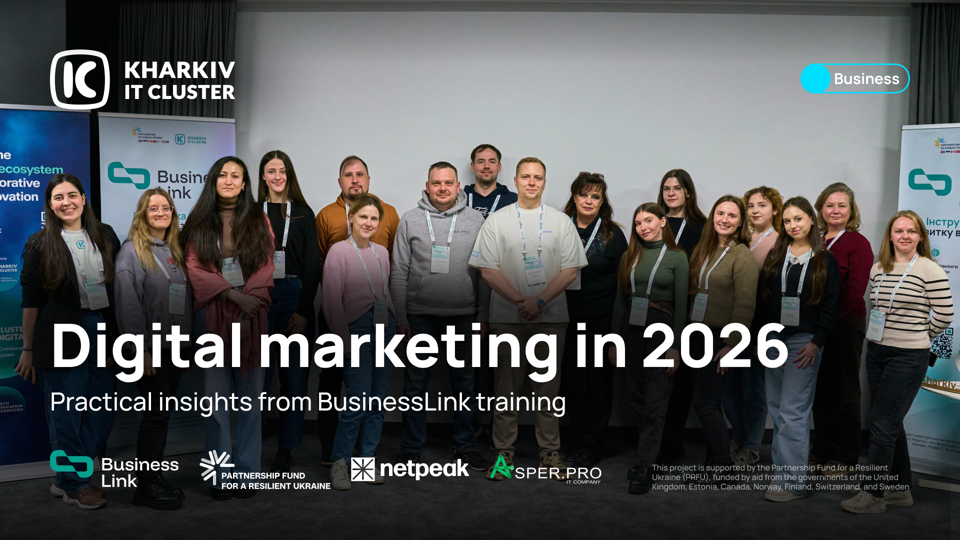
During the BusinessLink training organized by Kharkiv IT Cluster, experts explained where companies most often “drain” online marketing budgets and what to do about it in 2026.
This article is based on speeches given by Mykola Novikov, Head of SEO at Netpeak, and Eugene Kovalov, CEO of Asper.pro.
Why doesn't traditional SEO guarantee results anymore?
Just a few years ago, SEO followed a simple and predictable model: businesses targeted keywords, optimized pages, and received organic traffic from Google. Today, that model has changed significantly.
In many industries, the first organic search result appears only after paid ads and AI Overview blocks — Google’s AI-generated answers. As a result, companies may invest heavily in SEO, but users never even scroll down to the organic results.
There is, however, an important exception: transactional queries such as “buy,” “order,” or “price.” For these searches, AI-generated blocks often do not dominate the results page, meaning organic rankings can still perform effectively.
That is why the first thing businesses should check today is whether AI Overview appears in their niche. This determines whether a traditional SEO strategy is still effective or whether adaptation to the new search logic is required.
GEO: How can you make AI recommend your business?
With the rise of ChatGPT, Gemini, and other LLM-based systems, a new direction is emerging — GEO (Generative Engine Optimization).
Its purpose is not only to rank in Google search results, but to ensure that AI systems recommend your company directly in their answers.
Previously, users received a list of links. Now, they increasingly receive ready-made answers containing recommendations for specific brands, services, or products.
For AI, it is not a single factor that matters, but rather a combination of signals: technical website quality, media mentions, brand activity on social media, customer reviews, content expertise, overall digital reputation.
In practice, the formula looks like this:
Technically strong website + media presence + solid digital reputation = a chance to appear in LLM-generated answers.
This is no longer theory but a real market shift. According to Mykola Novikov, Head of SEO at Netpeak, after optimizing e-commerce content for LLM visibility, one German project achieved:
- +693% traffic from AI systems;
- +120% revenue from AI-driven traffic within four months.
How AI “reads” content: what matters for LLM?
AI systems do not read pages the way humans do. Instead, they extract individual fragments and decide whether those fragments are useful enough to include in a response. That is why content for LLMs must follow different principles than traditional SEO copywriting.
- Structure. Clear headings, short paragraphs, and summaries at the beginning of long articles help AI systems understand page content faster. AI analyzes information in blocks rather than as a continuous text flow, so chaotic or overloaded content performs worse.
- Specific facts. Phrases like “recently” or “many clients” provide little value for AI systems. Models work far better with precise dates, numbers, and measurable results such as “in April 2025,” “over 200 completed projects,” or “35% growth.” These details are more likely to be used in AI-generated responses.
- Verified expertise (E-E-A-T). Anonymous content or articles without clear authorship are treated less favorably by LLMs. Even high-quality material can lose visibility if the system cannot determine who created it and why the source should be trusted.
- Self-contained paragraphs. Each paragraph should make sense independently from the rest of the article. If a section depends too heavily on previous context, AI systems may ignore it entirely when generating answers.
- Freshness. In industries where information changes rapidly, updated content has a major advantage. An article published in 2019 and never updated will almost always lose to content refreshed in 2024–2026.
- Unique data. When choosing between rewritten content and original research, AI systems prefer the original source. That is why proprietary case studies, research, statistics, and exclusive insights are becoming the key competitive advantage in the LLM era.
6 technical issues that cause e-commerce business to lose sales
One of the biggest mistakes companies make is scaling advertising before checking the technical quality of their website. In such cases, increasing the budget simply accelerates financial losses. Eugene Kovalov, CEO of Asper.pro highlighted several critical areas where online stores most commonly lose conversions.
- Broken core functions. “Buy” buttons, filters, shopping carts, or checkout pages may not work correctly on different browsers or devices. Business owners are often unaware of these issues. That is why regular manual testing of key user user scenarios manually.
- Poor website speed. Google evaluates website performance under slow mobile internet conditions. A slow website negatively affects both SEO rankings and conversion rates.
- Incorrect filter logic. One of the most common e-commerce problems is poorly configured product filters. For example: “out of stock” products appear first; relevant items fail to display; filters conflict with each other. As a result, users simply leave the website.
- Weak product pages. Many businesses treat them as technical elements, when in reality they function as landing pages. It is essential to check how they appear across different devices. Special attention should also be paid to “out of stock” and “available on request” states, which are often empty and fail to guide the customer on what to do next.
- Ignoring wish lists. If a user added a product to a wish list but did not purchase it, that person is already a warm lead. Offering a discount a few days later is significantly cheaper than attracting a new customer from scratch.
- Security issues. Outdated plugins, standard admin panel URLs, and weak passwords are among the most common causes of website hacks.
Online Marketing in 2026 Is No Longer Only About Advertising
Today, businesses compete not only for visibility in Google, but also for presence inside AI-generated answers.
If in the past it was enough to launch ads and optimize SEO, results now depend on an entire digital ecosystem:
- technical website quality;
- content structure;
- digital reputation;
- brand expertise;
- adaptation to AI-driven search logic.
That is why website audits, content optimization, and strong brand visibility in the information space are becoming fundamental requirements for staying competitive online.
This article was prepared based on the BusinessLink training organized by Kharkiv IT Cluster.
BusinessLink is a project supporting SMEs, including businesses in frontline regions, relocated companies, and veteran-owned businesses. Register to receive invitations to future events: registration form.
The project is implemented with the support of the Partnership Fund for a Resilient Ukraine (PRFU), funded by aid from the governments of the United Kingdom, Estonia, Canada, Norway, Finland, Switzerland, and Sweden.
Read also
All news
A new underground facility for Kharkiv’s municipal dispatch service 1562, which operates under the Department of Emergency Situations of the Kharkiv City Council, has been equip...
Read more
Diia.Business is a support hub for the local business community, focused on entrepreneurship development and the digital transformation of small and medium-sized enterprises.Kha...
Read more
Kharkiv IT Cluster, in partnership with the National Qualifications Agency and with the participation of 20 companies, educational institutions and organizations, has prepared a...
Read moreSubscription to the email newsletter
Want to stay updated on the latest IT events in the region?
Subscribe to our newsletter!