

Kharkiv,
Gromadyanska St., 11/13
August 14, 2026
The return of veterans to the workplace raises many questions for HR professionals and managers: how should you conduct an interview, what working conditions should you offer, how should you prepare the team, and where is the line between support and excessive attention?
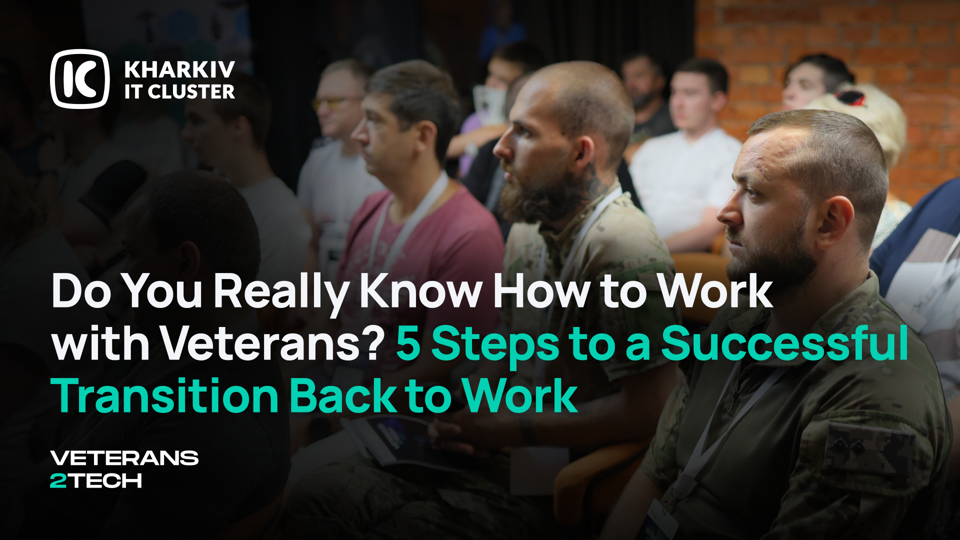
We discussed these questions during the Kharkiv IT Cluster event “Veteran Adaptation in the Team: Practical Steps for HR”. Kateryna Shepel, a clinical psychologist, and Hennadii Vietrov, a member of the Kharkiv branch of the NGO “Veteran Corps”, explored common mistakes employers make and shared advice that can help make veterans’ adaptation more comfortable.
We have collected 5 key steps for HR professionals and managers to consider.
1. Communicate clearly about the job and do not diminish military experience
Phrases such as “stress resistance,” “ability to work in a multitasking environment,” or “communication skills” tell a candidate little about what they will actually be expected to do.
The more specific the description of tasks, work format, expectations, and conditions, the easier it is for a candidate to understand whether the position is right for them. This is important not only for veterans, but for everyone looking for a job.
Military experience is a separate issue. A recruiter may simply not know what stands behind a position such as “squad commander” or another military specialty. But that does not mean this experience has nothing to offer a civilian business.
People management, responsibility for decision-making, working according to procedures, planning, and team coordination are all skills that can be valuable outside the military.
What HR can do: do not reject a candidate because you are unfamiliar with their military job title. Instead, find out what skills and experience stand behind it.
2. Do not turn the interview into a conversation about the war
A veteran comes to an interview not to talk about their combat experience.
Questions about the circumstances of an injury, combat missions, fear, or psychological state do not directly help determine whether a person is suitable for a particular position. Moreover, they may be uncomfortable or even traumatic.
An interview should remain an interview: talk about professional experience, competencies, responsibilities, and working conditions.
If a person needs certain conditions to work comfortably, you can ask about this appropriately: “Is there anything that would help you work comfortably in our team?”
And then listen to the answer rather than making assumptions on the person’s behalf.
3. Do not treat veteran status as a person’s defining characteristic
Sometimes a company may go to one of two extremes.
- The first is to perceive a veteran as a potentially “problematic” employee and anticipate aggression, instability, or difficult behavior.
- The second is to feel excessive pity, constantly remind the person of their veteran status, or try to create special conditions they have not asked for.
Both approaches can interfere with normal work.
A veteran is first and foremost a person, a professional, and a member of the team. Like other employees, they need clear tasks, honest feedback, opportunities for development, and trust.
HR and managers do not need to become psychotherapists. What matters more is knowing how to support an employee appropriately and where to refer them for professional help if they need it.
4. Think about the work environment, not just the job responsibilities
Sometimes the problem is not the work itself, but the way it is organized. For example, constant noise, conversations nearby, phone calls, a printer next to the workstation, or the need to monitor several processes at once can create additional cognitive load.
This may be particularly relevant for people experiencing the effects of concussions or traumatic brain injuries.
Therefore, instead of automatically requiring someone to be “good at multitasking,” it is worth considering whether all tasks really need to be performed simultaneously.
What can be done:
- give tasks sequentially and clearly define priorities;
- reduce unnecessary noise in the workplace where possible;
- allow the employee to work in a quieter area or use headphones, where appropriate;
- avoid unnecessary switching between tasks;
- inform employees about changes in plans or processes in advance.
The role of HR and the manager is to determine, together with the employee, the conditions that will help them work comfortably.
5. Prepare not only the veteran, but the entire team
It is impossible to talk about adaptation if only one person is being prepared for it.
Colleagues may also not know how to communicate appropriately with a veteran. As a result, they may instead avoid conversations, ask uncomfortable questions, or behave overly cautiously.
There is no need to turn a veteran into an “office hero” or make them a constant topic of conversation.
It is enough to explain the basics to the team: do not ask about the war without the person’s consent, respect personal boundaries, do not make assumptions about their condition, and treat them like any other colleague.
Likewise, a person should not be forced to participate in every corporate event or loud celebration. An invitation — yes, pressure — no.
The return of veterans to civilian life is a shared responsibility
The most important thing is not to try to guess what a veteran needs, but to ask and listen to the answer.
Someone may need a quieter workplace. Someone may need clearer tasks. Someone may not need any additional conditions at all. There is no universal scenario. That is why comfortable adaptation begins not with a ready-made checklist, but with respect, normal communication, and the company’s willingness to be flexible.
At Kharkiv IT Cluster, we continue to develop our veteran-focused initiatives and look for new opportunities to support veterans in the professional environment.
If you represent a veteran organization, work with veteran communities, or have your own initiatives for veterans — email us at education3@it-kharkiv.com. We would be happy to connect, exchange experience, and explore opportunities for cooperation together 🤝
Read also
All news
Kharkiv IT Cluster is launching a new era of cooperation by signing a memorandum with the American non-profit organization TechHope Transitions Inc.The new international partner...
Читати повністю
Diia.Business is a support hub for the local business community, focused on entrepreneurship development and the digital transformation of small and medium-sized enterprises.Kha...
Читати повністю
Many entrepreneurs start their digitalization journey by searching for CRM, ERP, or other digital services. However, experts advise against rushing to choose software. The first...
Читати повністюSubscription to the email newsletter
Want to stay updated on the latest IT events in the region?
Subscribe to our newsletter!