

Kharkiv,
Gromadyanska St., 11/13
11 February 2026 y.
Today is an opportunity to celebrate women in STEM — so we’re highlighting the journey of one of Veramed’s biostatisticians.
Nowadays more and more girls are choosing technical fields, leading teams, and creating solutions that change lives. Among these areas is biostatistics, which to many may sound complex and abstract. But for Mariia Pavliuk, Principal Statistician at Veramed, it's the perfect combination of technical skill and real-life impact.
In this interview, you’ll discover her journey from Maths Olympiads to international clinical research, learn about Veramed’s culture, and why biostatistics is, above all, about people.
How a Childhood Passion Became a Future Profession
Mariia fondly remembers her maths lessons at school. She dedicated her Saturdays to extra classes, and summer vacations turned into a time of intensive learning at a maths school.
She regularly took part in maths Olympiads, where preparation required discipline and perseverance.
Maria recalls: "We had our own maths community — students from about ten schools across Ukraine who met every year at Olympiads. We knew each other, supported one another, and competed, and that created a special atmosphere that reminds me a lot of my current professional community."
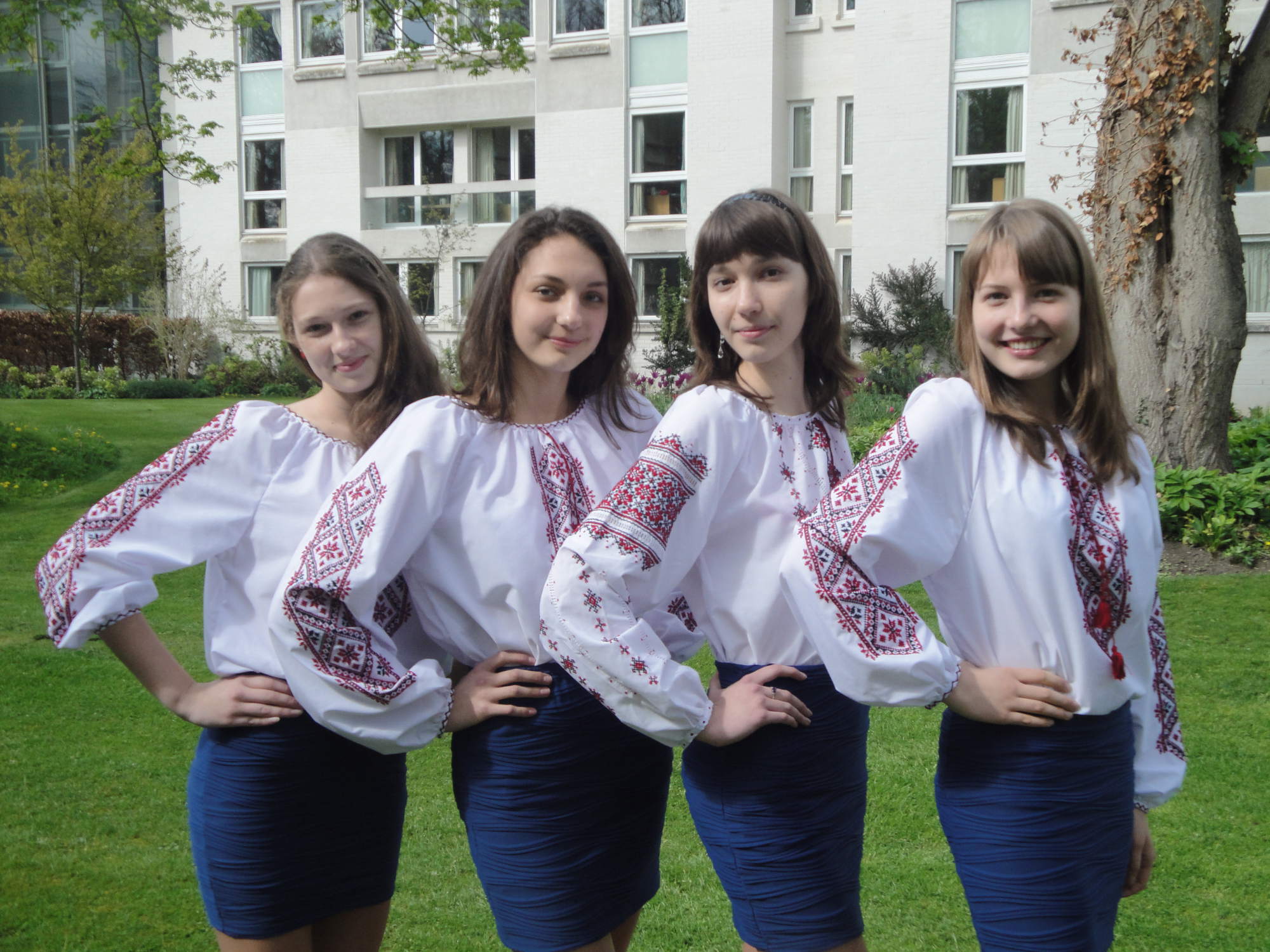
Photo: Team Ukraine at the first EGMO Olympiad (Cambridge, United Kingdom, 2012)
Team members (from left to right): Olena Kharytonova (silver), Yuliia Kravchenko (silver), Mariia Pavliuk (silver), Yaroslava Serdiuk (silver)
An interesting fact from Mariia’s biography: in 2012, she joined the Ukrainian team at the very first European Girls’ Mathematical Olympiad (EGMO), held in Cambridge, UK. The Ukrainian team achieved an impressive result, taking third place.
EGMO was created to encourage girls to pursue mathematics and provide opportunities for self-realization. Although called a European Olympiad, teams from the USA, Saudi Arabia, and Indonesia also participated. For Mariia, this was a pivotal moment that confirmed her talent and passion for exact sciences.
After school, she looked for a field that combined mathematics with practical applications and chose the Faculty of Cybernetics with a specialization in Systems Analysis — where algorithms and real-world problems worked hand in hand.
Systems Analysis: The Science of Seeing the Bigger Picture
Systems Analysis teaches you to “step into” any field — from transport and logistics to finance or healthcare — and understand how it works, where the weak points are, and how it can be optimized.
Mariia recalls that students solved not only abstract mathematical problems but also some real-life business and technical cases. Essentially, it meant learning to see the system as a whole: how a logistics company optimizes routes to deliver parcels faster and cheaper; how airlines plan flights; or how developers think about safety and cost-effectiveness when designing new aircraft.
“It means,” says Mariia, “that I can analyze any system. I can enter any field and understand what’s happening there.”
In her senior years at university, Mariia began to have doubts: too much maths, too many abstractions, and too little real-world practice. The turning point came with a course on SAS — a programming language widely used in clinical research. The graduate student teaching the course offered Mariia an internship — and that was the pivotal moment. This is how she entered an industry that perfectly matched her specialty, and she has been developing in this field for over nine years now.
That’s how statistics opened the door to the world of medicine — where data directly impacts patients’ lives.
Placebos, Hypotheses, and the Mysteries of Data: The Work of a Biostatistician
Clinical research is often surrounded by myths and misconceptions: some imagine secret experiments, others — conspiracy theories about pharmaceutical companies. In reality, it’s a clearly structured, ethical, and strictly controlled process that lasts for years and costs hundreds of millions of dollars. And at the center of this process is the biostatistician.
“When I say I’m a biostatistician, people often think I’m a doctor working in a lab. In fact, that’s not the case at all. My day is spent at a computer: large volumes of data, study plans, statistical models,” says Mariia.
Clinical research is the core of developing new medicines. It is a multi-stage, strictly regulated process of testing a drug’s safety and efficacy in humans. The biostatistician ensures the scientific integrity of this process: defining analysis methods, preparing the statistical analysis plan, and outlining which tables, charts, and summary reports will be generated from the collected data.
This field is subject to a high level of control because it concerns human life and health. Therefore, the full cycle — from laboratory experiments to the completion of all clinical trial phases — requires significant resources and costs hundreds of millions or even billions of dollars.
Phases of Clinical Trials
- Preclinical phase: The substance is tested in laboratories and on animals to assess its potential effect and safety.
- Phase I: Up to 20 healthy volunteers receive the substance to check its distribution in the body and possible side effects.
- Phase II: Around a hundred patients with the condition test the optimal dosage and effectiveness of the drug.
- Phase III: Approximately a thousand participants help confirm safety and efficacy, and based on these data, regulators can make the decision to release the drug.
The typical format of a clinical trial is a double-blind randomized study. Patients are randomly assigned to two groups: one receives the active drug, the other a placebo. Neither patients, doctors, nor statisticians know who is taking what, to avoid bias.
Only after treatment ends does the so-called “unblinding” occur — revealing who received the drug and who received the placebo. Then the final programs are executed, and the primary hypothesis can be tested: does the health status differ between the treatment group and the placebo group?
The core competency of a biostatistician is statistics, as it forms the foundation for hypothesis testing and accurate data interpretation. A biostatistician determines how to analyze study results to obtain reliable conclusions: planning the analysis, choosing approaches based on data type and study design, and collaborating with physicians and researchers to correctly interpret clinical indicators. Importantly, the biostatistician is involved even at the study planning stage — to ensure that data will be collected in a way that allows for proper analysis and credible results. This interdisciplinary work guarantees that statistical conclusions reflect the real picture.
Beyond mathematics, strong English skills are essential for biostatisticians to enable them to work with international teams. Additionally, they must have the ability to lead meetings, ask the right questions, and present results. Mariia also emphasizes attention to detail: thousands of patients, dozens of parameters, and any small discrepancy can affect the conclusions.
“We have to anticipate the fact that patients may not perfectly follow the trial protocol” says Mariia. “The statistician is responsible for checking all the data and understanding how it will impact the interpretation of the final study.”
Internships: The Gateway to Biostatistics
For most young specialists in clinical research, everything starts with an internship. Companies consciously invest in newcomers, teaching them programming in SAS and R from scratch and introducing them to clinical trial standards.
“You join a company, and employees spend a significant amount of their time explaining, showing you everything that’s going on, and teaching you the basics,” Mariia explains.
That’s why an internship is a kind of exchange: the company invests time and knowledge, while the intern gets the opportunity to learn from professionals, master a niche field, and, if they prove themselves, stay with the company.
Mariia’s Biostatistics Journey with Veramed
Mariia has now been working at Veramed for over five years. Before that, she had experience at another company, but in Veramed she found an environment that truly aligns with her values. She was particularly drawn to the opportunity to work with small pharmaceutical companies, where people are deeply committed to their ideas, as well as the focus on humanity, transparent communication, and a healthy balance between work and personal life.
When Mariia joined Veramed, its Ukrainian office was still very young, and she started out with just a few colleagues. Today, the team in Ukraine has grown to more than 50 people.
A career in biostatistics can take several paths. You can become a Delivery Statistician — managing projects from start to finish, designing analyses, and being accountable for results. You can move into consulting — advising pharmaceutical companies at the planning stage of clinical trials. Or you can choose a technical track, focusing on programming and developing innovative analytical methods.
Veramed even offers its own graduate training program (GTP) for people with no prior experience in clinical research: three months of intensive learning of SaS and R followed by three months of practice — giving them the fundamental skills to begin their biostatistics journey.
Mariia proves that the right company can become a true school of professional growth. At Veramed, she found both support and the opportunity to realize her potential.
In addition, Veramed offers a vibrant social life: every month, employees can join a variety of engaging cultural and entertainment activities — from excursions and workshops to sports events — as well as take part in volunteering initiatives together with colleagues. For example, last year Mariia initiated a Birdwatching Marathon, and her colleagues eagerly joined in. Activities like these are a great way to unwind and switch gears, especially given the complexity of the work, and they also create opportunities to connect in an informal setting.
Behind Every Number is a Person
Mariia’s story is about courage, perseverance, and love for her craft. We are grateful to her for an honest and heartfelt account that shows: behind the statistics are people and dreams.
“Don’t be afraid to try something new: the opportunities are there, and your effort will directly shape the results,” emphasizes Mariia.
On the International Day of Women and Girls in STEM, this reminder is especially valuable: the world of science and technology is open to everyone who is ready to learn and take action.
About Veramed
Veramed is a Clinical Research Organization (CRO) that supports biotech and pharmaceutical clients with their clinical studies across the drug development lifecycle. Veramed's guiding principle is biometrics as a force for good - striving for positive impact for its employees, clients, and patients.
Founded in 2012, Veramed has always been built on quality, integrity, humanity and a desire to do things differently. This has fostered a culture that genuinely cares for its employees, and employees that genuinely care about the work they do.
Veramed is dedicated to setting the highest standards for biometrics in clinical trials and is seeing incredible growth, but remains a close, collaborative community, championing culture and people as its greatest asset.
Read also
All news
Kharkiv IT Cluster is launching a new era of cooperation by signing a memorandum with the American non-profit organization TechHope Transitions Inc.The new international partner...
Читати повністю
Diia.Business is a support hub for the local business community, focused on entrepreneurship development and the digital transformation of small and medium-sized enterprises.Kha...
Читати повністю
Many entrepreneurs start their digitalization journey by searching for CRM, ERP, or other digital services. However, experts advise against rushing to choose software. The first...
Читати повністюSubscription to the email newsletter
Want to stay updated on the latest IT events in the region?
Subscribe to our newsletter!